1. Executive Summary: The Commercial Retail Hygiene Standard in the UK
Maintaining an impeccably sanitized commercial retail environment is a direct driver of consumer footfall, brand equity, dwell time, and transactional revenue across the United Kingdom. Whether operating an independent boutique along a bustling high street, managing a multi-floor department store within an enclosed shopping centre, or presenting prestige vehicles across an expansive automotive dealership, first impressions fundamentally shape customer purchasing behavior. In the British retail market, cleanliness is not merely an aesthetic consideration; it is a critical operational standard governed by strict Health and Safety Executive (HSE) workplace regulations, Food Standards Agency (FSA) hygiene criteria, and British Institute of Cleaning Science (BICSc) technical protocols.
Modern retail spaces face intense customer turnover and foot-traffic soil loading. Tens of thousands of shoppers deposit outdoor grit, road salt, rainwater, and biological residues across entrance matting and sales floor tiles daily. Simultaneously, fitting room mirrors, product display vitrines, glass counters, till touchpoints, and payment card terminals accumulate skin oils, fingerprints, and bacterial contamination. A retail space that displays scuffed flooring, dusty merchandise shelving, streaked entrance glazing, or neglected customer washrooms directly damages consumer confidence, prompting shoppers to leave for competing retail destinations.
Specialized commercial retail and shop cleaning services in the UK deliver tailored janitorial architectures designed to protect retail assets while minimizing trading disruptions. From dawn pre-opening sweeps and out-of-hours night-shift industrial scrubbing to rapid-response daytime spill management, professional cleaning contractors ensure retail premises remain pristine, compliant, and welcoming. This comprehensive 2026 commercial guide provides an authoritative operational blueprint for retail store managers, facilities directors, and automotive dealership principals, detailing technical cleaning standards, specialized car showroom detailing, HSE slip and trip compliance, floor-care machinery, and commercial contract budgeting benchmarks.

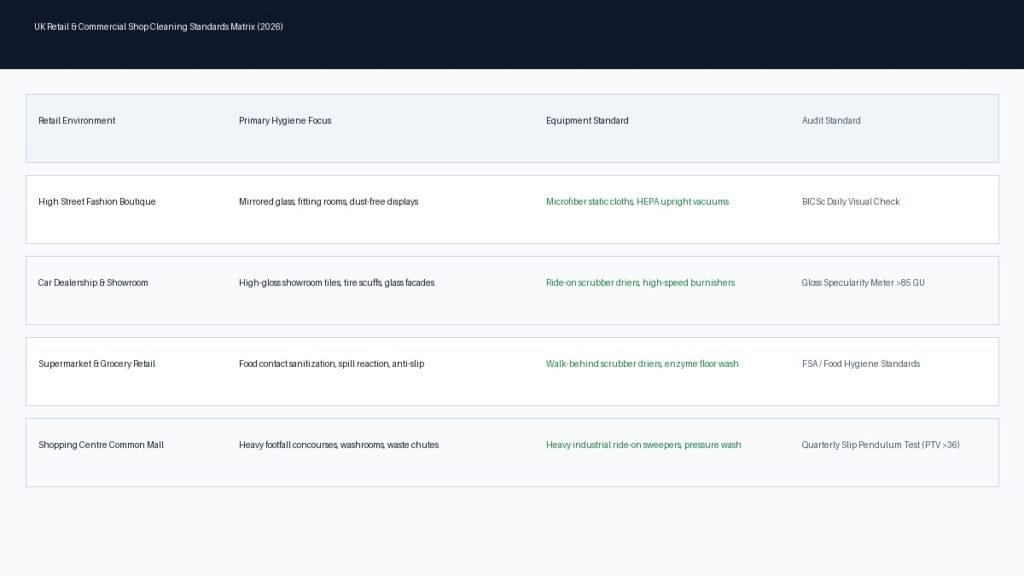
Figure 1: Technical cleaning standards, equipment specifications, and quality audit benchmarks across UK retail environments.
2. Technical Retail Cleaning Specifications Across Diverse Commercial Formats
The UK commercial retail sector comprises diverse physical environments, each presenting unique architectural profiles, footfall patterns, and hygiene vulnerabilities. A standardized generic approach to retail cleaning fails to address the distinct demands of specialized stores.
A. High Street Fashion Stores and Luxury Boutiques
Fashion retail demands immaculate presentation to accentuate fabric textures and premium garments:
- Glazing and Vitrine Maintenance: Entrance glass, exterior window displays, and internal mirrored columns must be cleaned daily using pure demineralized water and lint-free microfiber cloths to eliminate fingerprints and smudges that detract from visual merchandising displays.
- Fitting Room Hygiene: Fitting rooms represent high-contact personal spaces where customers interact with merchandise while undressed. Floors must be vacuumed or damp-mopped twice daily, mirrors polished, fitting room benches disinfected, and garment hooks cleared of debris.
- Anti-Static Carpet and Hardwood Care: High-traffic fashion carpets accumulate lint, thread clippings, and grit that abrade carpet fibers. Daily commercial HEPA upright vacuuming preserves pile appearance and removes dust allergens, while engineered hardwood sales floors receive pH-neutral damp mopping to prevent moisture damage.
B. Supermarkets, Grocery Stores & Food Retail
Food retail facilities operate under dual scrutiny from local Environmental Health Officers (EHO) and the Food Standards Agency (FSA):
- Refrigerated Display Case Sanitization: Chilled food cabinets, dairy decks, and meat display cases accumulate organic condensation, dairy residues, and bacterial biofilms (such as Listeria monocytogenes). Daily sanitization using BS EN 1276-approved food-safe antimicrobial biocides is mandatory.
- Continuous Daytime Spill Response: Dropped bottles, broken egg containers, and leaking milk cartons present severe, immediate slip hazards. Supermarkets require dedicated daytime janitorial staff equipped with mobile spill kits and dry-mop systems to cordon off and sanitize spill zones within 90 seconds.
- Bakery and Delicatessen Degreasing: In-store bakeries and hot food counters require daily industrial degreasing of stainless steel surfaces, rotisserie ovens, extraction hood filters, and slip-resistant safety flooring using hot-water pressure injection and food-contact-approved degreasers.
C. Shopping Centres and Enclosed Retail Malls
Covering tens of thousands of square metres, regional shopping centres demand industrial-scale logistical coordination:
- Concourse and Atrium Maintenance: Main public concourses require overnight deployment of ride-on industrial scrubber driers (such as the Nilfisk SC6500) equipped with dual cylindrical brush decks to scrub and dry thousands of square metres before 08:00 trading.
- Customer Washrooms and Baby Changing Suites: Shopping centre washrooms experience intensive, continuous public use. Contract specifications mandate hourly washroom servicing, continuous restocking of paper towels and anti-bacterial foaming soap, toilet descaling, and touchpoint sanitization.
- Waste Compaction and Loading Docks: Commercial waste management teams handle continuous pallet clearance, cardboard baling, general refuse compaction, and service tunnel disinfection to prevent rodent harborage and odor migration into public shopping areas.
3. Automotive Car Showroom Cleaning: Precision Presentation Standards
Automotive dealerships and commercial car showrooms represent one of the most demanding, specialized retail sectors in the commercial cleaning industry. A prestige automotive showroom housing luxury executive saloons, high-performance sports cars, or heavy commercial utility vehicles requires presentation standards akin to an art gallery or corporate boardroom. The showroom floor acts as an architectural frame that amplifies vehicle paintwork, chrome accents, and showroom illumination.
A. Showroom Floor Detailing & High-Gloss Mirror Finish
The defining visual feature of a premier car showroom is its high-gloss, ultra-reflective floor. Showroom floors typically feature high-spec porcelain vitrified tiles, polished architectural terrazzo, or high-build polyaspartic epoxy resins:
- The Problem of Rubber Tire Scuff Marks: Vehicle tires contain chemical plasticizers and vulcanized rubber compounds that transfer directly onto showroom floor tiles as cars are repositioned. Standard mops merely smear these rubber residues. Professional showroom cleaning teams deploy industrial rotary scrubber driers loaded with specialized melamine cleaning pads or fine-grit diamond polishing disks paired with citrus-based natural solvent degreasers to dissolve rubber friction marks without dulling tile glaze.
- High-Speed Ultra Burnishing: Following rotary wet scrubbing, floors are polished using ultra-high-speed electric burnishers operating at 1,500 to 2,000 RPM. This thermal friction process hardens floor finishes and creates an optical gloss rating exceeding 85 Gloss Units (GU), allowing the underside of vehicles to reflect perfectly on the floor plane.
- Daily Dust Control: Throughout daytime trading, vehicle sales executives and visiting customers track airborne road dust onto showroom floors. Cleaning operatives utilize wide static-attracting scissor sweeps treated with non-oily mineral conditioning solutions to glide beneath display cars, lifting dust without scratching vehicle lower body cladding.
B. Full-Height Architectural Facades & Showroom Glazing
Modern dealerships feature floor-to-ceiling glass curtain walls engineered to showcase inventory to passing highway motorists:
- External Pure Water Reach-and-Wash: Exterior showroom facades extending up to 60 or 80 feet are detailed using vehicle-mounted ionic water purification systems. Water is passed through five-stage reverse osmosis and de-ionization filters to achieve 0 parts per million (PPM) total dissolved solids. Applied through carbon fiber telescopic water-fed poles, the demineralized water absorbs atmospheric pollution and evaporates spot-free without squeegeeing.
- Internal Glass Smear Elimination: Customers viewing vehicles frequently lean against perimeter glazing. Internal glass is cleaned using alcohol-based rapid-drying glass cleaners and waffle-weave microfiber glass towels, ensuring zero hazing or streak lines under intense showroom spotlighting.
C. Customer Consultation Lounges & Handover Bays
The vehicle handover bay is where clients complete the emotional purchase of a new automobile:
- Handover Bay Detailing: Handover suites receive surgical pre-delivery cleaning: floors swept and burnished, ambient track lighting dusted, private consultation desks polished, and presentation turnaround areas cleared of clutter.
- Hospitality Bar & Customer Coffee Lounges: Customer waiting lounges feature leather armchairs, barista coffee bars, and digital configuration tablets. Leather upholstery is cleaned with pH-balanced leather hide conditioners, coffee service counters disinfected, and commercial espresso machine drip trays cleared and sanitized.
D. Electric Vehicle (EV) Indoor Charging Bay Sanitation
With the rapid transition toward electric mobility, modern automotive showrooms feature indoor EV display pods and dedicated rapid-charging demonstration stations:
- High-Voltage Safety Precautions: Cleaning operatives receive specialized health and safety briefings regarding high-voltage tethered charging cables. Operatives never apply conductive liquid solutions directly to charging plugs or open vehicle charging ports.
- Heavy Cable Grime Removal: Heavy charging cables dragged across showroom floors accumulate grease and particulate dirt. Cables are wiped down using non-conductive, fast-evaporating solvent wipes to ensure a pristine tactile experience for showroom guests.
- Under-Chassis Inspection Mirror Detailing: Many EV dealerships display vehicle battery platforms on raised mirrored display turntables. Mirrored turntables receive daily anti-static glass treatment to prevent dust cling and showcase battery architecture under showroom spotlights.
E. Workshop Service Reception & Parts Counters
Dealership service receptions bridge customer areas and vehicle repair workshops:
- Grease and Hydrocarbon Tracking Control: Technicians and customers walking from workshop bays track engine oil, brake dust, and hydraulic fluids toward reception tiles. Cleaning teams place heavy commercial absorbent capture matting at all transition doors and perform twice-daily deep degreasing of service desk floors using emulsifying alkaline cleaners.
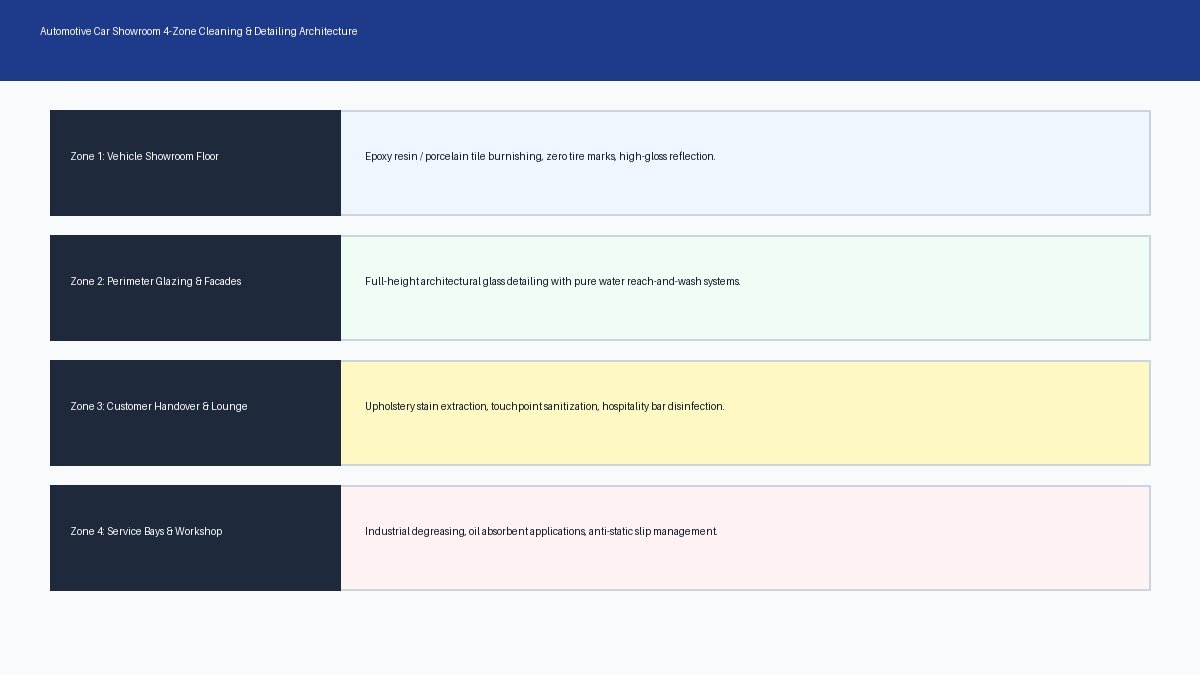
Figure 2: Four-zone automotive dealership hygiene framework: showroom floor burnishing, perimeter glazing, handover suites, and service bays.
4. Health & Safety Executive (HSE) Compliance: Slips, Trips & COSHH Standards
Commercial retail operators in the UK bear statutory legal duties under the Health and Safety at Work etc. Act 1974, the Management of Health and Safety at Work Regulations 1999, and the Workplace (Health, Safety and Welfare) Regulations 1992. In retail premises, slip, trip, and chemical exposure risks represent the single largest category of reported employee and customer personal injury claims.
A. Slip Resistance and Pendulum Test Value (PTV) Standards
According to Health and Safety Executive statistics, slips and trips account for over 40 percent of all major reported retail workplace injuries, costing the UK commercial retail sector millions annually in compensation claims and insurance premium hikes:
- The British Standard BS 7976-2 Pendulum Test: The HSE recognizes the pendulum friction test as the benchmark methodology for measuring floor slip resistance. The test measures the dynamic friction coefficient of a surface in wet and dry states, generating a Pendulum Test Value (PTV).
- The Statutory Safety Threshold (PTV >= 36): A floor surface must achieve a minimum wet Pendulum Test Value of 36 to be classified as having a “Low Slip Potential.” Surfaces scoring between 25 and 35 have “Moderate Slip Potential,” while scores below 24 indicate “High Slip Potential.”
- Cleaning Method Impact on Slip Resistance: Inappropriate cleaning chemicals are a primary cause of high slip potential. If a cleaning crew uses dirty mop water or oily pine-based detergents, a greasy residue film builds up in microscopic tile pores, transforming an otherwise slip-resistant porcelain tile into a dangerous hazard when exposed to shoe moisture. Professional cleaning contractors utilize neutral synthetic detergents and mechanical scrubber driers that extract dirty water immediately, leaving floors clean and instantly dry.
B. COSHH Regulations (Control of Substances Hazardous to Health)
Every chemical agent deployed across retail premises must comply with COSHH statutory regulations:
- COSHH Assessment Dossier: A comprehensive physical binder containing material safety data sheets (MSDS) and risk assessment profiles for every chemical (degreasers, descalers, toilet cleaners, glass polishes) must be maintained in a designated on-site cleaning store.
- Locked Chemical Storage: Chemical concentrates must be stored inside secure, locked metal cabinets to prevent unauthorized access by store staff or members of the public.
- Dilution Control Systems: Professional contractors install automated wall-mounted dilution dispensers that mix chemical concentrates with exact water ratios, eliminating chemical over-concentration that damages floors or creates toxic inhalation risks for operatives.
D. Sustainable Cleaning: EU Ecolabel and Defra Procurement Standards
Modern British retail brands place corporate social responsibility and environmental sustainability at the core of their facilities procurement. Commercial cleaning contractors increasingly deploy biotechnology and plant-based surfactant chemistries compliant with Defra Government Buying Standards and certified under the EU Ecolabel scheme:
- Zero Volatile Organic Compounds (VOCs): Traditional solvent-based cleaners release airborne VOCs that compromise indoor air quality for retail store staff and visiting shoppers, exacerbating asthma and respiratory sensitivities. Modern enzymatic formulations utilize bacterial cultures to break down fats and proteins at neutral pH without hazardous fumes.
- Ultra-Microfiber Split Fiber Mechanics: High-grade commercial microfiber cloths feature split fibers measuring 1/16th the diameter of a human hair. The wedge-shaped polyester and polyamide matrix creates strong capillary action that lifts and locks microscopic bacteria and dust particles within the cloth fabric rather than pushing soil around surfaces like traditional cotton mops. Used dry, electrostatic charges attract dust; used damp with water, split microfibers remove up to 99 percent of surface microbes without requiring harsh chemical bleaches.
- Plastic Waste Minimization via Reusable Concentrate Cartridges: Leading contractors eliminate single-use plastic bottles across retail stores by installing closed-loop water dilution systems utilizing super-concentrated chemical sachets or recyclable aluminum pods, reducing site plastic packaging waste by up to 90 percent.
Cross-contamination between restroom facilities and customer sales areas represents a severe public health hazard. Professional retail cleaners adhere strictly to the British Institute of Cleaning Science four-color zoning standard:
| Color Code | Designated Retail Area | Designated Equipment & Materials |
|---|---|---|
| Red | High-Risk Sanitary Zones (Toilet bowls, urinals, washroom floors) | Red cloths, red mop heads, red buckets, red toilet brushes |
| Yellow | Washroom Fixtures (Sinks, towel dispensers, tiles, mirrors, cubicle doors) | Yellow cloths, yellow buckets, yellow rubber gloves |
| Green | Food Handling & Prep (Staff canteens, bakeries, coffee stations) | Green food-grade cloths, green squeegees, green abrasive pads |
| Blue | General Sales Floor (Display units, till desks, customer lounge, offices) | Blue microfiber cloths, blue dusters, blue damp mop systems |
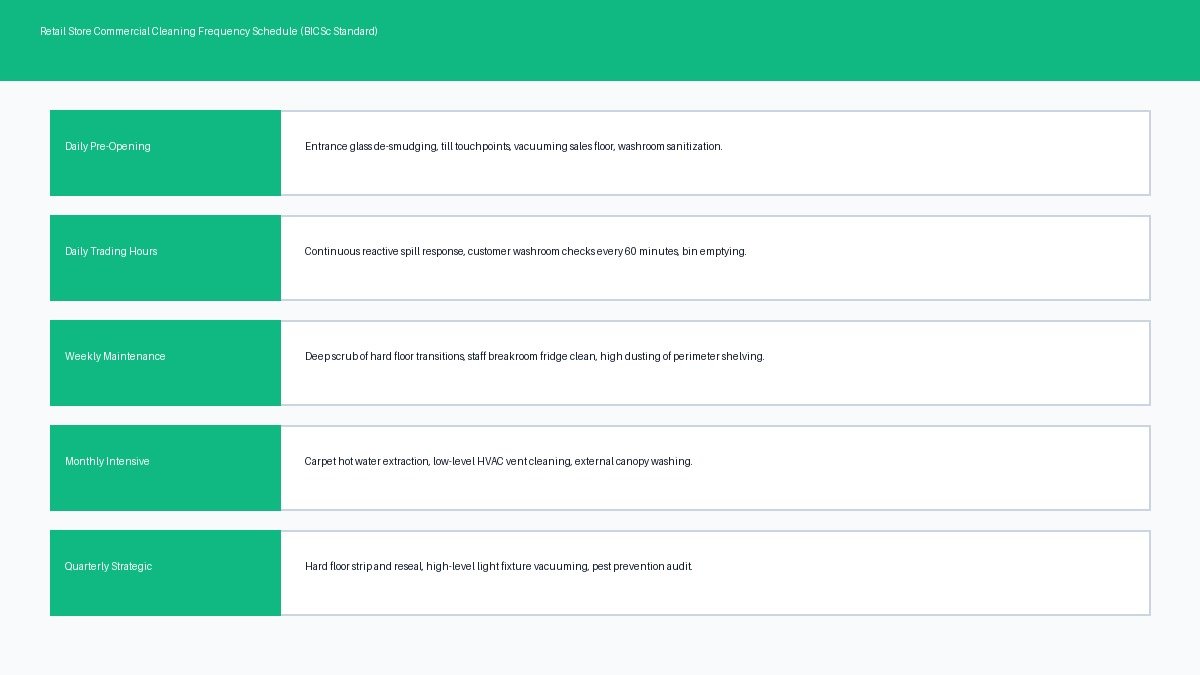
Figure 3: Structured commercial cleaning schedule mapping daily, trading-hours, weekly, and periodic retail tasks.
5. Master Retail Cleaning Protocols: Daily, Trading Hours & Periodic Deep Cleans
High-performing retail stores rely on synchronized cleaning schedules aligned with customer trading patterns. Combining pre-opening hygiene resets with periodic maintenance prevents long-term aesthetic decline.
A. Pre-Opening Early Morning Reset (06:00 to 09:00)
The dawn cleaning shift restores the retail premises to pristine condition prior to unlocking store doors for the trading day:
- Entrance Threshold: Exterior pavements swept, entrance matting vacuumed, cigarette receptacles emptied, and exterior threshold plates wiped down.
- Sales Floor Mechanical Scrubbing: Walk-behind scrubber driers navigate aisles, removing dried footfall residues and restoring floor slip resistance.
- Glass and Mirror Polishing: Display vitrines, perimeter glazing, and fitting room mirrors polished to remove fingerprints and hazing.
- Touchpoint Sanitization: Payment terminals, point-of-sale touchscreens, counter pens, escalator handrails, and fitting room locks sanitized with virucidal wipes.
- Washroom Reset: Full washroom sanitization, toilet descaling, mirror cleaning, floor mopping with red-coded systems, and restocking of paper and soap consumables.
B. Trading-Hours Day Janitorial Coverage
For high-footfall department stores, grocery supermarkets, and busy shopping malls, daytime janitorial presence provides critical reactive maintenance:
- Rapid Spill Management: Immediate response to liquid spills, dropped merchandise, and wet rainwater tracking at entrance lobbies, deploying high-visibility yellow “Caution: Wet Floor” safety signage.
- Continuous Washroom Verification: Washrooms inspected on 45 to 60-minute cycles, addressing toilet blockages, mopping wet basin counters, clearing discarded paper towels, and ensuring continuous soap availability.
- Fitting Room Turnover: Periodically clearing garment hangers, stray price tags, and packaging debris from fitting room stalls to maintain customer flow.
C. Practical Dealership Case Study: West Midlands Automotive Group
To examine the measurable commercial return of professional cleaning, consider the operational transformation of a prestige German automotive dealership in the West Midlands. Operating a 1,400 square metre showroom with 22 display vehicles and a high-traffic service reception, the dealership struggled with dull porcelain tiles, persistent tire scuff marks, and streaked 8-metre perimeter glazing under their previous in-house cleaners.
Upon transitioning to a specialized commercial contract with CCSN, the following technical protocol was implemented:
- Nightly Scrubber Drier Scrubbing: Deploying a Nilfisk walk-behind scrubber drier with melamine diamond pads and an alkaline emulsifier, eliminating 100 percent of rubber tire marks daily.
- Bi-Weekly 2,000 RPM Burnishing: Ultra-high-speed polishing restored floor gloss readings from an uninspiring 42 Gloss Units to an exceptional 88 Gloss Units, creating an immaculate mirror reflection beneath showroom sports cars.
- Fortnightly Exterior Reach-and-Wash: Telescopic carbon fiber poles utilizing 0 PPM pure demineralized water eliminated traffic film from roadside facade glass.
- Outcome: In quarterly manufacturer customer audit surveys, the dealership’s “Showroom Presentation & Cleanliness” rating climbed from 76 percent to 98.4 percent, earning the franchise a national brand excellence bonus while eliminating customer slip incidents entirely.
D. Periodic Deep Cleaning and Hard Floor Restorations
Daily cleaning maintains surfaces, but periodic deep cleaning restores underlying materials:
- Quarterly Hard Floor Strip and Seal: For vinyl, linoleum, and terrazzo floors, older polymer emulsion floor finishes are stripped using chemical emulsifiers and rotary stripping pads, followed by applying three to four coats of high-solids slip-resistant polymer sealant.
- Hot Water Carpet Extraction: Carpeted retail sales floors receive dual-vacuum hot water extraction (steam cleaning) using pressurized water at 60 to 70 degrees Celsius to dissolve ground-in traffic lane dirt, beverage spills, and allergens.
- High-Level Dusting and Light Fixture Detailing: Using specialized carbon fiber vacuum extension poles and mobile elevated work platforms (MEWPs / scissor lifts), operatives remove electrostatic dust deposits from ceiling ductwork, track spotlighting, suspended banners, and HVAC return vents up to 30 feet above the sales floor.
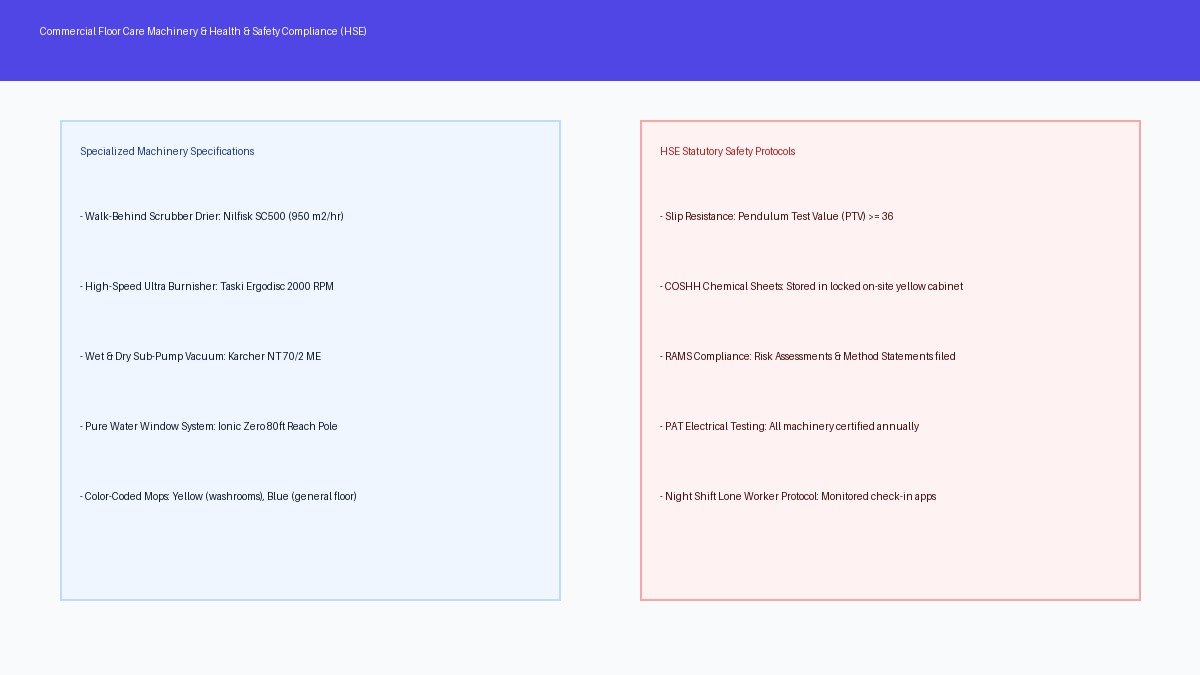
Figure 4: Industrial floor care machinery specifications and essential Health and Safety Executive safety protocols for UK retail stores.
6. Specialized Retail Machinery & Equipment Architecture
Professional cleaning results require purpose-built industrial machinery. Consumer-grade vacuums and traditional mop buckets cannot withstand the intensive operational demands of modern retail environments.
A. Walk-Behind and Ride-On Scrubber Driers
Scrubber driers represent the core workhorse of retail hard-floor maintenance. These machines combine high-pressure water and chemical injection, counter-rotating brush scrubbing, and high-suction squeegee recovery in a single pass:
- Compact Walk-Behind Units (e.g., Nilfisk SC401 / Karcher B 40 C): Engineered with narrow brush decks (430mm to 510mm) and tight turning radiuses, enabling operators to clean between narrow clothing racks, display gondolas, and checkout lanes. Operating speeds cover 1,200 to 1,800 square metres per hour.
- Ride-On Industrial Scrubber Driers (e.g., Tennant T16 / Nilfisk SC6000): Deployed in large department stores, wholesale cash-and-carry warehouses, and shopping mall concourses. Boasting 900mm to 1,000mm scrub paths and large clean water tanks (190 litres), these machines clean up to 6,000 square metres per hour while leaving floors bone-dry within three seconds of passage.
B. Ultra-High-Speed Rotary Floor Burnishers
To produce the mirror-like finish required in automobile showrooms and premium boutique stores, high-speed rotary burnishers (1,500 to 2,000 RPM) are essential:
- Thermal Friction Polishing: High rotational velocity generates localized heat that softens polymer floor finishes, closing microscopic pores and producing an exceptional reflective shine without chemicals.
- Active Dust Control: Modern commercial burnishers incorporate active HEPA vacuum skirts around the pad housing, capturing all pad-wear dust particles before they become airborne and settle on retail merchandise or vehicle bonnets.
C. Commercial Backpack Vacuums and HEPA Uprights
Vacuuming vast retail sales floors with bulky canister vacuums creates trip hazards and slows down staff. Modern contractors utilize ergonomic commercial backpack vacuums (such as the Numatic RSV150):
- Speed and Agility: Backpack vacuums allow operators to move freely around display fixtures, stairs, and narrow fitting corridors, increasing vacuuming productivity by up to 200 percent compared to standard tub vacuums.
- Multi-Stage HEPA Filtration: Retains 99.97 percent of dust particles down to 0.3 microns, preventing fine dust from being exhausted back into the retail atmosphere.
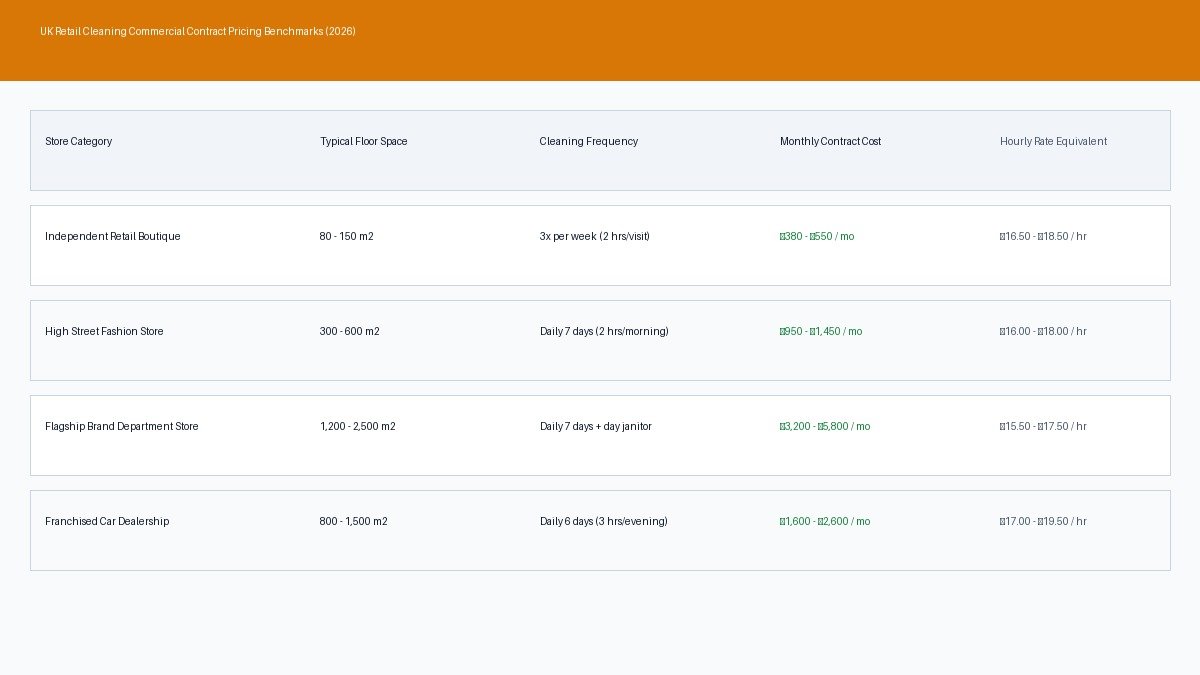
Figure 5: Commercial contract pricing benchmarks per square metre, monthly costs, and hourly rates across UK retail environments.
7. Commercial Retail Cleaning Contract Pricing Benchmarks (UK 2026)
Procuring commercial retail cleaning services in the UK requires transparent financial budgeting. Pricing is determined by physical square meterage, operational shift timing (daytime, early morning, or night shift), cleaning frequency, machinery requirements, and regional labor costs.
A. Core Pricing Variables in UK Commercial Cleaning
Contract charges reflect five foundational operational cost centers:
- Direct Labor Costs: Governed by the UK National Living Wage (rising to £12.21 per hour in 2025/2026), plus employer National Insurance contributions (15 percent), workplace pension auto-enrollment, and statutory holiday/sick pay allowances. In Greater London, rates are benchmarked against the London Living Wage (£13.85 per hour).
- Consumables and Chemicals: Professional contractors include eco-certified, COSHH-compliant chemical concentrates, color-coded microfiber cloths, and dilution equipment in monthly contract charges.
- Machinery Amortization & Maintenance: Capital depreciation, annual PAT electrical testing, and maintenance of rotary scrubbers, burnishers, and industrial vacuums.
- Management & Quality Auditing: Regular site visits by contract supervisors, digital audit reports with photographic evidence, and Key Performance Indicator (KPI) monitoring.
- Public & Employers’ Liability Insurance: Reputable commercial contractors carry minimum £10,000,000 Employers’ Liability and £5,000,000 Public Liability insurance coverage to protect retail clients from accidental property damage or customer injury claims.
B. Commercial Pricing Schedule by Retail Footprint
| Retail Facility Type | Floor Area (m2) | Cleaning Schedule | Monthly Contract Range (Ex. VAT) | Hourly Rate Equivalent |
|---|---|---|---|---|
| Independent Boutique Store | 80 to 150 m2 | 3 Days / Week (2 hrs/visit) | £380 to £550 / month | £16.50 to £18.50 / hr |
| High Street Fashion Retailer | 300 to 600 m2 | 7 Days / Week (2.5 hrs/morning) | £1,150 to £1,650 / month | £16.00 to £18.00 / hr |
| Franchised Car Dealership | 800 to 1,500 m2 | 6 Days / Week (3.5 hrs/evening) | £1,800 to £2,800 / month | £17.00 to £19.50 / hr |
| Supermarket / Food Retailer | 1,500 to 3,500 m2 | Daily Morning Scrub + Day Janitor | £3,800 to £6,200 / month | £15.50 to £17.50 / hr |
| Department Store (Multi-Floor) | 4,000 to 8,000 m2 | Night Team (4 Cleaners) + 2 Day Staff | £8,500 to £14,000 / month | £15.50 to £17.00 / hr |
8. Quality Auditing, SLA Architecture & TUPE Regulations
Securing consistent, long-term cleaning excellence requires establishing a measurable Service Level Agreement (SLA) backed by quantitative auditing frameworks and structured staff transition mechanisms.
A. Quantitative Cleaning Quality Audits (BICSc Criteria)
Professional cleaning managers do not rely on subjective visual impressions. Contracts utilize structured scoring audits assessing each operational zone across five standardized criteria:
- Dust and Particulate Accumulation: Zero visible dust on surfaces below 2 metres; zero cobwebs or particulate matter on high-level fittings.
- Floor Finish and Soil Removal: Hard floors free from grease films, sticky residues, and black scuff marks, maintaining consistent gloss specularity.
- Glass and Mirror Clarity: Complete absence of fingerprints, smears, mineral water spots, and lint fibers on display vitrines and fitting room mirrors.
- Restroom Sanitization & Odor Control: Clean microbiological swab tests on sanitary touchpoints, active descaling of toilet basins, and fresh ambient aroma.
- Consumable Availability: 100 percent continuous availability of hand soap, paper hand towels, toilet tissue, and sanitary disposal bags.
B. Navigating TUPE Regulations in UK Cleaning Retenders
When switching commercial cleaning providers, retail store managers must navigate the Transfer of Undertakings (Protection of Employment) Regulations 2006 (TUPE):
- Automatic Employee Transfer: Under UK employment law, when a cleaning contract transitions from an outgoing cleaning contractor to an incoming supplier, existing cleaning staff assigned primarily to the retail site automatically transfer to the incoming contractor on their existing terms and conditions of employment, preserving their length of continuous service.
- Employee Liability Information (ELI): The outgoing contractor is legally obligated to provide detailed ELI data (including employment contracts, wage rates, disciplinary records, and grievance histories) to the incoming contractor at least 28 days prior to contract commencement.
- Contractor TUPE Competency: Experienced commercial cleaning contractors manage the TUPE consultation process smoothly, integrating transferred staff into modern training protocols, issuing fresh uniforms, providing BICSc certified training, and boosting site cleaning morale.
C. Key Performance Indicators (KPIs) and Rectification Windows
Standard commercial retail cleaning contracts include contractual KPIs to ensure accountability:
- Overall Audit Score: Minimum monthly audit score of 85 percent to 90 percent. Scores falling below 80 percent trigger immediate managerial reviews and corrective training.
- Defect Rectification Window: Any reported critical defect (such as an unemptied washroom bin or smeared entrance glass) must be rectified within 2 to 4 hours during normal trading hours.
- Staff Attendance and Cover Reliability: 100 percent shift coverage guarantee. If an operative is absent due to illness, the contractor must deploy vetted relief staff within 60 minutes.
9. Summary Guide: How to Select a Vetted Commercial Retail Cleaning Contractor
When tendering commercial cleaning contracts, retail facilities managers should verify the following institutional credentials:
- BICSc Corporate Membership: Proof that the company adheres to British Institute of Cleaning Science operational standards and trains operatives under the Cleaning Professional’s Skills Suite (CPSS).
- ISO Certifications: Verification of ISO 9001 (Quality Management), ISO 14001 (Environmental Management), and ISO 45001 (Occupational Health & Safety).
- Enhanced DBS Vetting: In retail settings with after-hours keyholding access and high-value stock merchandise, all operatives must possess clean Disclosure and Barring Service (DBS) criminal background checks.
- Comprehensive RAMS Documentation: Site-specific Risk Assessments and Method Statements (RAMS) customized to the store’s physical layout, equipment, and public interactions.
10. Frequently Asked Questions Regarding Retail & Shop Cleaning Services
How often should a retail store be professionally cleaned in the UK?
Most high street retail stores and boutiques require daily commercial cleaning (either pre-opening or post-closing) to maintain floor slip resistance, detail glass vitrines, and sanitize customer washrooms. High-footfall department stores, grocery supermarkets, and shopping centres require both daily pre-opening deep cleans and ongoing daytime janitorial coverage to address spills and maintain washroom standards.
How do commercial cleaners remove stubborn tire marks from car showroom floors?
Tire scuff marks result from chemical plasticizer transfer from warm vehicle tires onto showroom floor tiles. Professional cleaners remove tire scuffs using industrial rotary scrubber driers fitted with specialized melamine foam pads or fine diamond polishing discs, combined with natural citrus-based solvent degreasers that break down rubber bonds without etching floor tile glazes.
What is the HSE Pendulum Test Value (PTV) requirement for retail floors?
The UK Health and Safety Executive mandates that commercial floor surfaces achieve a minimum wet Pendulum Test Value (PTV) of 36 or higher under BS 7976-2 to be classified as having a “Low Slip Potential.” Maintaining this safety threshold requires using neutral synthetic detergents and mechanical scrubber driers that extract dirty wash water immediately.
What is the BICSc color-coding system in commercial retail cleaning?
The British Institute of Cleaning Science (BICSc) color-coding standard assigns specific colors to cleaning equipment to eliminate biological cross-contamination: Red for high-risk sanitary zones (toilet bowls and urinals); Yellow for washroom basins, tiles, and cubicles; Green for food preparation and kitchen areas; and Blue for general sales floors, clothing racks, and offices.
How much does commercial shop cleaning cost per hour in the UK?
In 2026, standard commercial retail cleaning rates in the UK range from £16.00 to £19.50 per hour outside London, and £18.50 to £22.50 per hour within Greater London. Rates reflect the National Living Wage, employer National Insurance contributions, specialized equipment depreciation, and comprehensive public liability insurance.
Can cleaning operatives hold store keys for out-of-hours cleaning?
Yes. Many retail stores and car dealerships operate out-of-hours cleaning contracts where teams clean between 20:00 and 06:00. Reputable cleaning contractors enforce strict keyholding security protocols, including digital key receipt tracking, alarm code auditing, and mandatory Enhanced DBS criminal background checks for all assigned personnel.
What is the best way to clean full-height car showroom exterior glass?
Large showroom glass facades are cleaned using pure water reach-and-wash telescopic pole systems. Water is purified on-site through reverse osmosis and de-ionization filters to reach zero parts per million (PPM) total dissolved solids. When applied via carbon fiber poles, the demineralized water dissolves atmospheric grime and dries 100 percent spot-free without streaks.
How can retail stores prevent water tracking during rainy British weather?
Preventing slip hazards during wet weather requires a three-zone entrance matting system: Zone 1 (exterior scraper mats to remove coarse grit), Zone 2 (recessed primary entrance well matting to absorb moisture), and Zone 3 (secondary internal carpet runners). Daytime janitors must monitor entrance wells, deploying wet vacuums and high-visibility warning cones during storms.
What is the difference between daily maintenance and periodic floor stripping?
Daily maintenance involves rotary scrubbing and high-speed burnishing to clean surface grit. Periodic floor stripping involves applying heavy-duty chemical emulsifiers to dissolve worn, discolored polymer floor sealant down to the base vinyl or linoleum, followed by applying multiple coats of fresh slip-resistant polymer finish to restore gloss and protection.
What insurance should a commercial retail cleaning company hold?
A reputable UK commercial cleaning company must hold a minimum of £10,000,000 in Employers’ Liability Insurance (statutory requirement) and at least £5,000,000 in Public Liability Insurance, with specific endorsements covering damage to property being worked upon and keyholding indemnity.
How do cleaning companies manage lone worker safety during night shifts?
For operatives cleaning retail stores alone at night, contractors implement strict lone worker safety protocols in compliance with HSE guidelines. This includes GPS-tracked mobile lone worker check-in applications, automated inactivity alerts, panic buttons linked to 24/7 security monitoring centers, and scheduled supervisor check-ins.
How are food retail display refrigerators cleaned without contaminating food?
Chilled food display cases must be cleaned using BS EN 1276-compliant food-contact-safe antimicrobial biocides. All food merchandise is temporarily transferred into temperature-monitored holding chillers. Shelving and drain troughs are disinfected, rinsed, and dried completely before food products are restocked.
Can commercial cleaners work during store trading hours without disturbing shoppers?
Yes. Day janitors use ultra-quiet commercial vacuums (operating below 65 dB), ergonomic microfiber damp flat mops, and discreet mobile utility caddies. Staff are trained in retail etiquette, prioritizing customer right-of-way and minimizing noise in sales zones.
What should be included in a commercial retail cleaning Service Level Agreement (SLA)?
An SLA must specify exact cleaning task frequencies, quantitative audit scoring standards (targeting 85%+), defect rectification response windows (e.g., 2 hours for urgent washroom defects), staffing cover guarantees, and monthly managerial review schedules.
How does high-speed burnishing improve car showroom tile appearance?
Ultra-high-speed electric burnishers operating at 1,500 to 2,000 RPM create thermal friction that smooths out microscopic imperfections in floor finishes. This process enhances the floor’s gloss level to over 85 Gloss Units, creating an immaculate mirror reflection that elevates display vehicle presentation.
How are electronic payment keypads and POS terminals sanitized without damage?
Touchscreens, payment PIN pads, and barcode scanners are sensitive electronic devices prone to liquid short-circuits. Operatives never spray cleaning liquids directly onto terminals. Instead, they utilize pre-moistened 70 percent isopropyl alcohol disinfectant wipes, buffing keypads gently to destroy viruses and bacteria while evaporating immediately without leaving residues.
What procedures govern emergency clinical spill response in public retail malls?
Biological fluid spills (such as blood or vomit) in shopping malls require immediate containment under clinical biohazard protocols. The area is isolated with safety barriers, covered with chlorine-releasing absorbent granules (such as sodium dichloroisocyanurate) to neutralize pathogens, and scraped into yellow clinical waste bags for regulated incineration, followed by surface disinfection.
For UK retailers and automotive dealerships seeking certified commercial cleaning standards, partnering with vetted, BICSc-compliant cleaning contractors ensures your commercial premises consistently drive footfall, safeguard customer safety, and protect your commercial brand equity.