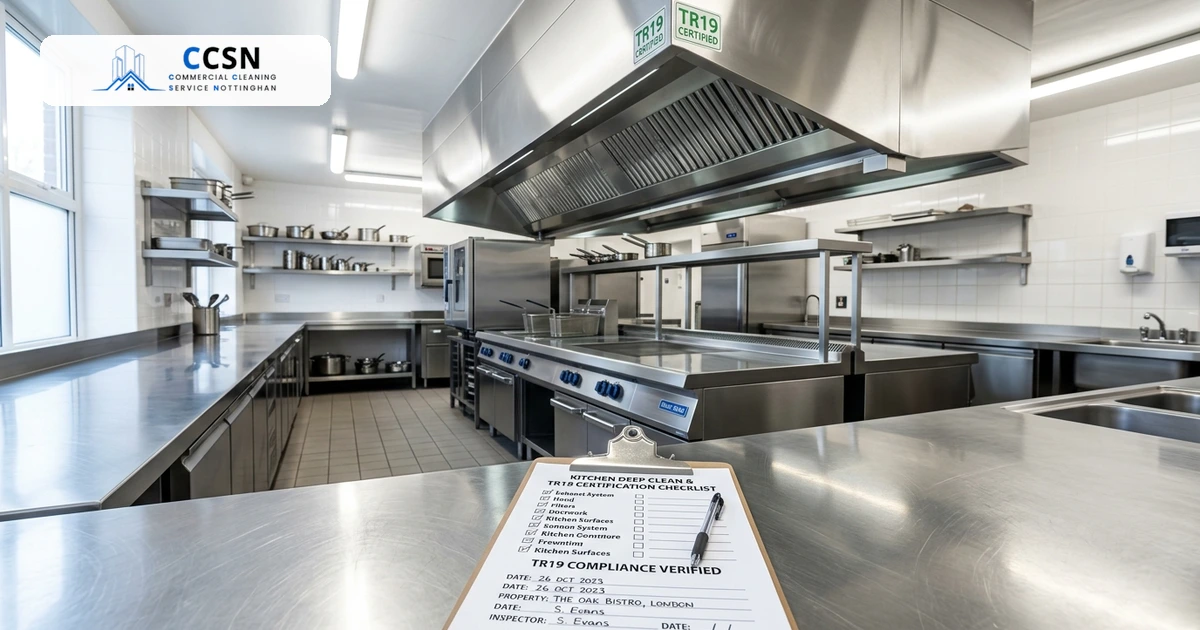
The Legal and Insurance Mandate for Kitchen Deep Cleaning Certificates
Operating a commercial food service facility across the United Kingdom requires strict adherence to statutory hygiene and fire safety legislation. Restaurant proprietors, hotel general managers, school caterers and care home operators carry direct legal responsibility for maintaining immaculate culinary environments.
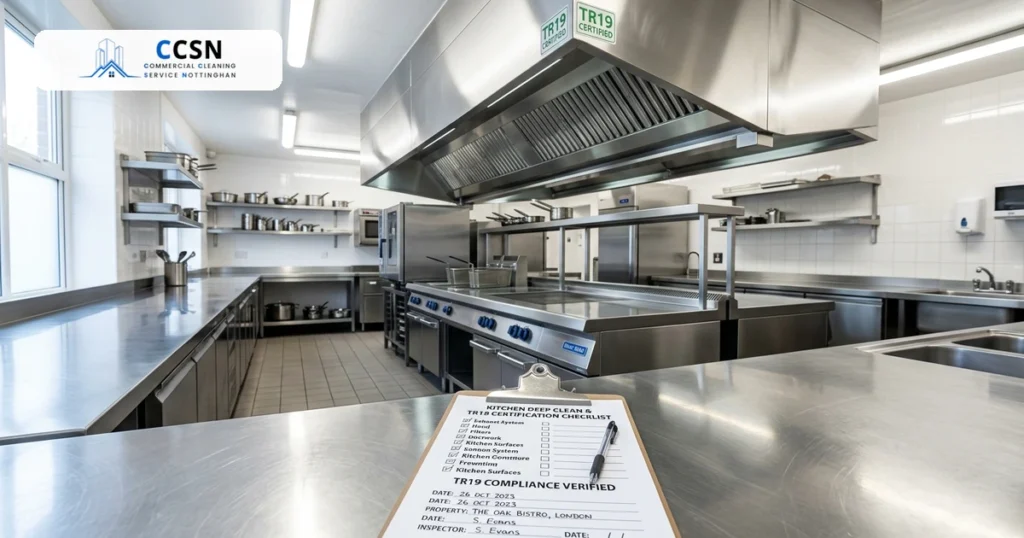
A commercial kitchen deep cleaning certificate serves as verified documentary evidence that your kitchen premises meet established national sanitation and fire prevention standards. Environmental Health Officers representing local municipal councils examine these certificates during unannounced food hygiene inspections to determine your official hygiene rating score. Operating without an authentic, accredited certificate exposes business owners to severe financial penalties, operational closure notices and reputation damage.
In addition, commercial property insurance underwriters require regular professional kitchen extract cleaning as an explicit condition of insurance policy coverage. If a grease-fueled kitchen fire occurs and the business cannot produce a valid compliance certificate, insurers routinely invalidate claims entirely. For specialized ventilation ductwork requirements, consult our detailed technical guide on kitchen extraction duct cleaning and TR19 grease compliance in the UK.
Understanding TR19 Grease Specifications and Industry Standards
The Building Engineering Services Association establishes the definitive national standard for kitchen ventilation hygiene through its recognized TR19 Grease specification. This technical guidance document dictates the inspection frequencies, testing methodologies and allowable grease deposit limits for commercial extract systems.
Cooking processes vaporize animal fats, vegetable oils and airborne grease particles that travel upward through canopy hood grease filters. Over months of intensive culinary operations, these volatile grease residues condense and solidify along internal ductwork surfaces, fan impellers and discharge cowls. Left untreated, accumulated grease transforms ventilation duct systems into continuous, highly flammable fuel lines running throughout commercial buildings.
Under TR19 regulations, internal ductwork surfaces must not exceed a mean grease deposit thickness of two hundred microns across measured test locations. Professional cleaning contractors utilize wet film thickness combs and calibrated magnetic gauges to record exact grease levels before and after servicing. Cleaning technicians remove solidified carbon deposits down to bare metal surfaces, restoring optimal airflow dynamics and eliminating severe combustion risks.
Key Components Inspected During Professional Kitchen Decontamination
A comprehensive commercial kitchen deep clean encompasses far more than routine nightly surface wipe-downs performed by in-house kitchen staff. Specialized industrial cleaning operatives target hidden, high-risk structural areas that daily kitchen operations cannot access safely.
The primary focal point remains the complete extract ventilation system including canopy hoods, baffle filters, horizontal ductwork and rooftop fans. Operatives cut sealed inspection access doors into enclosed duct runs at three-meter intervals, ensuring complete physical access throughout the entire duct length. Powerful rotary brushing systems and specialized food-safe degreasing chemicals dissolve stubborn grease without damaging galvanized steel duct walls.
Beyond ventilation infrastructure, technicians dismantle heavy commercial cooking ranges, convection ovens and preparation tables. Operatives pull heavy appliances away from walls to scrub rear panels, gas flex lines and floor drains thoroughly. Wall cladding surfaces, suspended ceiling tiles, refrigeration condenser coils and anti-slip safety flooring receive intensive steam sanitation.
Cleaning Frequencies Mandated by Culinary Operating Hours
The required frequency for professional commercial kitchen deep cleaning and certificate renewal depends directly on cooking volume and equipment usage. TR19 guidelines establish clear operational tiers based on daily cooking hours to guide commercial facility managers.
Commercial kitchens operating for twelve to sixteen hours daily in busy restaurants and hotels require quarterly servicing. Moderate operational facilities running between six and twelve hours each day must schedule professional deep cleaning every six months. Smaller establishments cooking for fewer than six hours daily, including primary school lunchrooms and boutique cafes, require annual certification.
Facility managers should maintain a rolling compliance calendar to ensure that certification audits occur before previous compliance certificates expire. Proactive scheduling prevents gaps in insurance coverage and demonstrates continuous organizational commitment to workplace health and safety. Facilities processing raw foods can review our guide on food manufacturing plant hygiene audits and BRCGS cleaning standards.
What an Accredited TR19 Cleaning Certificate Must Contain
A legally compliant kitchen deep cleaning certificate represents a comprehensive technical dossier rather than a single generic receipt. When hiring commercial cleaning contractors, facility directors must verify that the contractor delivers complete post-service documentation.
An authentic compliance certificate must explicitly record the contractor name, operative certification numbers, service execution dates and building address. The report must contain photographic proof documenting ductwork, fan housings and floor areas in before-and-after conditions clearly. Technicians must record precise micron thickness measurements across multiple documented test locations to verify that grease levels fall below statutory limits.
Additionally, the technical dossier must include a detailed schematic diagram illustrating the location of all installed access panels across the duct network. If certain duct sections remain inaccessible due to structural building obstructions, the certificate must explicitly document these limitations. Transparency protects facility managers during local council food hygiene audits and insurance underwriting reviews.
Legal Liabilities Under the Regulatory Reform Fire Safety Order
Under the Regulatory Reform Fire Safety Order 2005, business operators and designated responsible persons face direct criminal liability for fire safety negligence. If a commercial kitchen fire originates from poorly maintained grease extract systems, corporate directors can face severe criminal penalties.
Magistrates courts across the United Kingdom impose unlimited financial fines and potential custodial sentences on corporate officers who fail to mitigate known fire hazards. Fire and rescue authorities conduct unannounced audits of high-occupancy hospitality premises, demanding to inspect maintenance logs and current TR19 compliance certificates. Inability to produce valid certification can result in immediate prohibition notices that shut down commercial kitchens instantly.
Implementing regular certified deep cleaning protects commercial kitchen operators against devastating legal liabilities and corporate disruption. Routine professional maintenance proves due diligence under British safety statutes, demonstrating that business managers take active precautions to protect patrons and workers. Maintaining compliant records represents an essential pillar of responsible hospitality business management.
The Impact on Food Hygiene Rating Scores (FHRS)
In England, Wales and Northern Ireland, the Food Standards Agency operates the national Food Hygiene Rating Scheme displaying ratings from zero to five. Achieving a prestigious five-star hygiene score provides tremendous commercial advantages, attracting discerning customers and boosting catering contracts.
Environmental Health Officers assess three core pillars: food handling hygiene, physical building condition and food safety management systems. Presenting a current TR19 compliance certificate immediately satisfies inspector inquiries regarding structural cleanliness, ventilation hygiene and preventative maintenance controls. Conversely, greasy extraction canopies, stained ceiling tiles or uncertified ductwork trigger instant score deductions that lower your public rating.
Maintaining an active five-star rating reassures dining guests that your establishment prioritizes customer safety and exemplary sanitation. Investing in routine professional deep cleaning preserves brand reputation while safeguarding business profitability against damaging hygiene closures.
Selecting an Accredited Commercial Cleaning Partner in the UK
Choosing an uncertified or uninsured contractor to clean commercial kitchen extraction systems creates immense financial and legal vulnerability. Property owners must vet prospective cleaning contractors thoroughly before authorizing work inside commercial culinary premises.
Verify that your chosen contractor holds active membership in the Building Engineering Services Association and employs fully trained, certified ventilation hygiene operatives. Insist on reviewing proof of comprehensive public liability and efficacy insurance coverage with indemnity limits of at least five million pounds. Reputable contractors operate twenty-four hours a day, executing intensive deep cleaning during overnight closures without disrupting revenue-generating daytime service.
Working with an accredited commercial cleaning specialist ensures that your facility remains fully compliant with British fire regulations and food hygiene laws. Protect your investment, safeguard your staff and secure your insurance standing by maintaining verified kitchen deep cleaning certification year-round.